In the hyper-competitive American landscape of 2026, the traditional cost-saving playbook for mid-to-large scale enterprises has been fundamentally disrupted. US corporations are no longer satisfied with the legacy seat count models that once defined the industry, as the modern American consumer now demands a level of personalization and technical precision that offshore centers often struggle to provide. This shift has triggered a massive re-evaluation of how customer service outsourcing should function within a high-growth business model. Today, American leaders are prioritizing strategic value, data security, and specialized human empathy over the lowest possible price point. By moving toward more sophisticated, technology integrated partnerships, these organizations are transforming their support departments from reactive cost centers into proactive engines of customer lifetime value and brand resilience.
The Strategic Pivot from Cost Reduction to Brand Equity Preservation
For nearly three decades, the primary driver for American businesses seeking a third-party partner was the reduction of operational overhead. However, in 2026, the economic reality of quality debt has become impossible to ignore. Many US firms realized that the cents saved per interaction were being lost ten-fold through customer churn and negative brand sentiment. This realization is why so many American corporations are currently re-thinking their customer service outsourcing strategies. They are moving away from the high volume, low quality ticket factories of the past and toward boutique, high performance partners that act as a seamless extension of their own internal culture.
The American market is unique in its intolerance for friction. In a culture where convenience is a primary currency, a single poorly handled interaction can lead to a viral public relations crisis or a permanent loss of a high-value account. Consequently, customer service outsourcing is being redefined as a Brand Insurance policy. Companies are now looking for partners who can demonstrate a deep understanding of the American social fabric, including regional nuances and cultural expectations. This transition ensures that the brand’s voice is not just heard, but correctly interpreted, protecting the trust that took years to build from being eroded by a few minutes of poorly scripted communication.
The 2026 AI Revolution and the Human in the Loop Necessity
The arrival of Memory Rich AI has changed the baseline expectations for digital engagement across the United States. Automated systems are now capable of handling up to 80% of routine queries with a human-like understanding of context. This has led some to believe that the need for customer service outsourcing would diminish; however, the opposite has occurred. As machines take over the simple tasks, the 20% of interactions that reach a human agent are now significantly more complex, emotionally charged, and high-stakes. This complexity is why American firms are demanding higher-tier talent from their customer service outsourcing providers.
Today, a human agent is not a clerk but a specialist. They must be able to navigate complex software ecosystems, interpret real-time sentiment data, and make sophisticated judgment calls that an algorithm cannot authorize. This Human-in-the-Loop requirement is a central pillar of modern customer service outsourcing in the US. American corporations are seeking partners who invest heavily in agent retention and advanced training rather than just seat capacity. By empowering these specialists with AI-driven insights, organizations can provide a concierge-level experience that justifies the premium of a high-quality partnership, ensuring that no high-value customer is ever left frustrated by an uninspired or unhelpful response.
Security Compliance and the Rise of Onshore and Nearshore Models

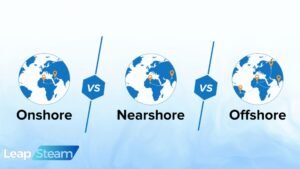
Data privacy has become a non-negotiable frontier for any brand operating within the United States. With the tightening of state-level regulations and the increasing threat of sophisticated cyber-attacks, American corporations are under immense pressure to ensure their data remains secure. This security mandate is a significant factor in why firms are re-thinking their customer service outsourcing locations. There is a noticeable shift away from traditional offshore destinations in favor of onshore (US-based) or nearshore (Latin America) locations that can provide stricter adherence to SOC2, and CCPA standards.
Proximity is becoming a proxy for security and operational synchronization. By utilizing a nearshore or onshore customer service outsourcing model, American firms can conduct real-time audits, enjoy shared time zones for agile collaboration, and benefit from a workforce that shares a similar regulatory and legal understanding. This proximity allows for a much tighter feedback loop between the support floor and the product development team. It ensures that any security vulnerability identified during a support interaction is neutralized immediately, rather than waiting for a distant time zone to wake up. In 2026, the peace of mind provided by a secure and compliant partner is worth far more than the marginal savings of a less-regulated provider.
Moving Toward Outcome Based Pricing and Strategic ROI
The legacy model of paying per-head or per-hour is rapidly being replaced by Outcome Based Pricing in the American BPO market. US corporations are re-thinking their customer service outsourcing by demanding that their partners have skin in the game. Instead of just paying for the time spent on a call, businesses are now paying for resolutions, customer satisfaction (CSAT) scores, and Net Promoter Score (NPS) improvements. This alignment of incentives ensures that the outsourcing provider is just as motivated to solve the root cause of an issue as the brand itself.
This shift turns the relationship from a vendor-client dynamic into a strategic partnership. When a provider of customer service outsourcing is focused on long-term outcomes, they become proactive rather than reactive. They begin to offer consultative insights, such as identifying common product friction points that are driving up call volumes. This level of business intelligence is invaluable for American firms seeking to stay lean and agile. By recognizing that customer support outsourcing is a data-rich environment, these corporations are mining their support interactions for the insights needed to inform their 2027 marketing and product roadmaps, ensuring that every dollar spent on support is also a dollar spent on innovation.
The Economic Impact of High Quality Support on US Market Resilience
Ultimately, the decision to invest in elite customer service outsourcing is driven by the stark economic reality of the American subscription economy. In a market where everything from software to groceries is delivered on a recurring basis, retention is the only sustainable path to profitability. A single negative experience can break a multi-year subscription chain, leading to a massive loss in projected revenue. Therefore, high-quality customer service outsourcing is being viewed as a primary driver of Customer Lifetime Value (LTV). American leaders understand that it is significantly cheaper to keep an existing customer happy through elite service than it is to acquire a new one through expensive digital marketing campaigns.
The brands that will win in the 2026-2030 window are those that realize their support channel is their most powerful marketing tool. By providing empathetic, localized, and technically sound customer service outsourcing, American firms are building a trust moat that protects them from the volatility of the market. This commitment to excellence proves to the global consumer that the American brand stands for more than just a product it stands for a relationship. As we move deeper into an era where AI handles the mundane, the human heart of the organization, represented by its support specialists, will be the final and most important differentiator for any corporation seeking to lead in the United States and beyond.
Frequently Asked Questions
What is the primary factor driving US companies to re-think their customer service outsourcing?
The primary factor is the shift toward Experience over Expense. American corporations have realized that low cost offshore models often lead to high churn and brand damage. In 2026, the focus has moved to Nearshoring and high quality talent that can provide a culturally resonant and technically accurate experience for the discerning US consumer.
How does customer support outsourcing impact a brand’s data security in the US?
In the modern era, data security is a top priority. Leading partners for customer service outsourcing now offer SOC2 and HIPAA compliant environments that often exceed a brand’s own internal security measures. By choosing a high-tier partner, US firms can actually strengthen their defensive posture against data breaches and regulatory fines.
Can AI tools replace human agents in a US-based customer service outsourcing model?
While AI now handles the majority of routine and data-heavy tasks, it cannot replace the human capacity for complex problem-solving and emotional empathy. The most successful American models use a hybrid approach where AI empowers human agents with real-time insights, allowing them to focus on high-value interactions that require human judgment and cultural nuance.
What is Outcome-Based Pricing in the context of customer service outsourcing?
This is a modern pricing model where the brand pays for specific results such as successful resolutions or CSAT targets rather than just the hours an agent spends at a desk. This ensures that the outsourcing partner is financially motivated to improve efficiency and quality, leading to a much higher return on investment for the American corporation.