In the hyper-accelerated digital landscape of 2026, the success of an artificial intelligence model is no longer defined solely by its architecture, but by the sovereignty of its data. As Generative AI and Large Language Models (LLMs) reach peak maturity, the demand for high-fidelity, human-verified datasets has transformed data labeling services from a back-office utility into a mission-critical engineering asset. For enterprise AI teams, the primary bottleneck is no longer compute; it is the availability of ground-truth data. This shift has placed a spotlight on the world’s elite data labelling companies that provide the specialized expertise required to train models for complex, regulated industries. Choosing a partner from the top data labelling companies is now the definitive factor in whether an AI project achieves production-grade accuracy or remains a proof-of-concept failure.
1. Leap Steam
Leapsteam has secured its place at the top of the 2026 rankings by redefining the full-stack embedded model of data annotation. Headquartered in Vietnam, the world’s newest high-performance engineering hub, Leapsteam specializes in high-governance delivery and domain-specific expertise. Unlike traditional data labelling companies, Leapsteam focuses on building dedicated engineering pods that act as a seamless extension of the client’s internal culture. Their product-first mindset ensures that their specialists offer proactive architectural feedback rather than just following tickets. They handle multimodal annotation text, image, video, and live streaming with a heavy emphasis on accuracy and safety across five continents.
Features
- Embedded Engineering Pods: High-tier specialists that adopt your internal culture and specialized workflows.
- Multimodal Technical Triage: Advanced processing and labeling of text, image, video, and audio data.
- High-Governance Protocols: Specialized handling of legally sensitive and culturally nuanced material.
- Moderator Resiliency Tech: A strong organizational culture focused on mental well-being to maintain high-performance standards.
- Multilingual Content Management: Managing and mitigating risks associated with sensitive material across various sectors.
Pros:
- Extreme Accuracy: Maintains a high accuracy rate across data-intensive projects by identifying inappropriate content.
- Technical Sovereignty: Teams act as safety architects rather than low-cost laborers.
- Global Resilience: 24/7 coverage ensures that First Contact Resolution is a reality for global users.
Cons:
- Linguistic Depth: Managing risks through multilingual email and content support for diverse global sectors.
2. VisionRepo
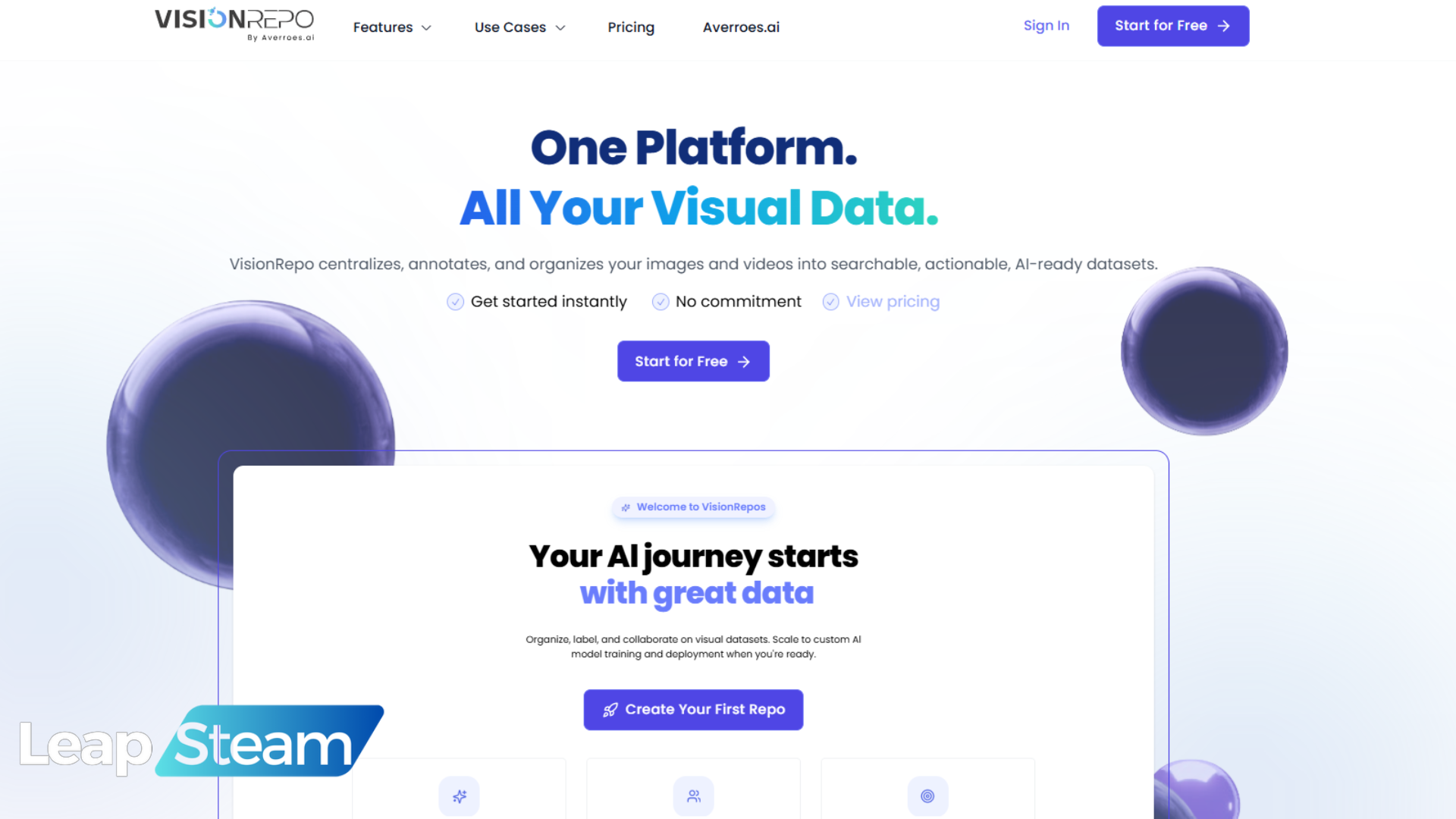
VisionRepo is the primary choice for teams that refuse to send their data out to anonymous workforces. In 2026, as data privacy regulations tighten, VisionRepo allows you to keep everything in-house. It’s a platform designed to manage labeling projects across images and videos, run AI-assisted annotation, and maintain real QA workflows with traceability down to the label level. It is one of the few data labelling companies that prioritizes the platform over the workforce, giving the power back to the internal data scientist.
Features
- AI-Assisted Annotation: Pixel-level precision for images and video using machine learning pre-labels.
- Multi-Stage Review: Built-in consensus validation and reviewer performance tracking.
- Searchable Repository: Centralizes visual data into a governed workspace with full version history.
- API & SDK Integration: Seamless connection with your existing ML or MLOps stack.
Pros:
- Full Data Ownership: Keep complete data governance with no third-party handoffs.
- AI-Powered Speed: AI assistance speeds up manual labeling by up to 10x.
- Auditable Traceability: Every label and revision is tracked for high-stakes compliance.
Cons:
- No Managed Crowd: Unlike other data labelling companies, you must provide your own internal annotators.
- Complexity: Advanced customization features are limited to the enterprise tier.
3. TaskUs
TaskUs helps some of the world’s biggest tech companies train and fine-tune AI systems at scale. They are frequently cited as one of the top data labelling companies for autonomous vehicle (AV) and LLM training pipelines, where they process millions of images monthly. They blend human accuracy with AI-enhanced workflows to deliver end-to-end model support, moving beyond simple tagging into adversarial stress testing.
Features
- AV-Specific Services: Includes simulation testing, scenario curation, and live fleet support.
- LLM Enhancement: Response scoring, classifier training, and adversarial bias testing.
- Hybrid Model: Combines trained human reviewers with machine learning automation.
- Resiliency Training: Comprehensive support systems for moderator mental health and longevity.
Pros:
- Lifecycle Coverage: Supports not just labeling, but model training, testing, and optimization.
- Strong Performance: Maintains high accuracy standards for complex visual tasks.
Cons:
- Outsourcing Tradeoffs: Less suited for clients needing ultra-sensitive, in-house-only workflows.
- Upfront Setup: Advanced projects may require deep, time-consuming coordination.
4. Appen
If your AI project involves multiple data types and hundreds of languages, Appen is likely your most viable partner. With over 25 years of experience, they are a giant among data labelling companies, specializing in massively scalable, human-in-the-loop data labeling services. What sets them apart is their ability to pair robust quality assurance with massive operational scale across disparate geographies.
Features
- Multi-Modal Annotation: Expert handling of text, audio, image, video, and geospatial labeling.
- Global Crowd: Access to over one million contributors for unmatched linguistic coverage.
- Custom Ontologies: Supports highly domain-specific annotation rules for complex sectors.
- Enterprise Controls: Consensus scoring, gold benchmarks, and project tracking dashboards.
Pros:
- Unmatched Scale: Trusted by Fortune 500 enterprises for projects involving millions of samples.
- Global Reach: Annotators across the world ensure cultural and linguistic accuracy.
Cons:
- Opaque Pricing: Custom quotes only, often making it inaccessible for smaller startups.
- QA Management: Consistency can vary slightly when working with such a massive crowd.
5. TELUS International
With over a billion annotations under its belt, TELUS International is helping define the enterprise standard for data labelling companies. Backed by its proprietary GT Studios platform, TELUS offers a full-stack solution for teams building AI that spans borders and complex, regulated data types like medical imaging or robotics.
Features
- GT Studios Platform: AI-assisted labeling, workflow orchestration, and integrated analytics.
- Sensor Fusion: Specialized support for text, audio, image, video, sensor, and geospatial data.
- High Throughput: Capability to handle billions of labels per year across petabytes of data.
Pros:
- Regulated Expertise: Meets the strictest standards for healthcare and automotive compliance.
- Project Oversight: Embedded quality controls and dashboards streamline delivery.
Cons:
- Scale Optimization: May not suit very small or one-off “boutique” projects.
6. Centific
Centific is the partner for serious AI teams doing more than just simple labeling. They deliver an AI data foundry that covers training, fine-tuning, evaluating, and deploying models. As one of the more technologically advanced data labelling companies, Centific is purpose-built for high-stakes AI development where safety is non-negotiable.
Features
- AI Workflow Orchestration: Automate model training, benchmarking, and RAG pipelines.
- Risk Tools: AI governance tools to assess model safety and prevent jailbreaking.
- Expert Network: Access to 1.8M domain experts, including 150+ PhDs and 4,000+ AI engineers.
Pros:
- Full Lifecycle Focus: Offers model training and governance alongside annotation.
- Enterprise-Grade: Trusted by Global 500 companies for complex, multi-stage AI.
Cons:
- Steep Learning Curve: Platform complexity may be overkill for early-stage teams.
7. Accenture
Accenture remains a heavyweight for enterprise-level data labeling services. They integrate responsive and evolving controls with advanced human expertise to maintain safe digital environments. Their focus on platform integrity makes them a standout among data labelling companies for industries requiring strict adherence to legal and ethical standards.
Features
- UGC Moderation: Removing inappropriate material like hate speech and explicit content.
- Advertising Review: Evaluating ads for compliance with platform policies and legal standards.
- IP Management: Monitoring digital media to protect intellectual property rights.
- Developer Compliance: Assessing apps to meet regulatory obligations and platform requirements.
Pros:
- Hybrid Approach: Combining AI-powered tools with trained human moderators for contextual accuracy.
- Trust Builder: Helping businesses build trust with users, partners, and regulators.
Cons:
- Complex Onboarding: Enterprise-grade investment and onboarding favor very large organizations.
Conclusion
Choosing between the top data labelling companies in 2026 comes down to your specific needs for control, scale, and technical depth. If you require a high-governance partner that operates as an extension of your own team, Leapsteam is the definitive strategic choice. For those who prioritize absolute data ownership and in-house platform control, VisionRepo remains the standout. Global enterprise players like Appen and TaskUs continue to dominate in raw volume, while Accenture provides the regulatory safety net needed for complex IP and advertising compliance. Invest in a partner that understands that your training data is your brand’s most valuable asset.
Frequently Asked Questions (FAQ)
What is the difference between manual and automated data labeling?
Manual labeling is done entirely by humans, while automated labeling uses AI to pre-label data, which is then verified by humans. In 2026, most data labelling companies use a hybrid approach to maximize efficiency without losing precision.
How long does it take to label a massive dataset?
It depends on the dataset size and complexity. Small projects can take days; enterprise-scale datasets can span weeks. Look for data labelling companies that offer clear SLAs (Service Level Agreements) and scalable teams.
Can I use multiple data labelling companies for the same project?
Yes, but it adds coordination complexity. Some companies do this to compare quality, though it is more efficient to choose a single vendor with strong internal QA and scalability.
Would you like me to draft a custom data quality audit to help you evaluate if your current datasets meet these 2026 standards?