
In the fast-paced digital economy of 2026, understanding what your customers feel in real time is no longer a luxury, it is an absolute business necessity. Sentiment analysis in live chat leverages advanced Natural Language Processing (NLP) to decode customer emotions instantly, transforming raw text into actionable insights. For B2B and B2C brands alike, this technology identifies frustration early, highlights upselling opportunities, and drastically improves agent performance. However, maximizing this technology requires continuous, uninterrupted monitoring. This comprehensive guide explores how sentiment analysis works, its undeniable business benefits, and why scaling enterprises strategically choose to outsource livechat 24/7 to fully harness emotional intelligence around the clock.
1. What Exactly is Sentiment Analysis?
At its core, sentiment analysis often referred to as opinion mining is a highly specialized subset of Artificial Intelligence (AI) and Natural Language Processing (NLP). It is designed to automatically read, interpret, and categorize the emotional tone behind a body of text. In the context of live chat support, it acts as a digital empath, scanning incoming messages from customers to determine if their underlying emotion is positive, neutral, or negative.
The Mechanics of Emotional Detection
When a customer types a message into a chat widget, they are conveying much more than just a request for information; they are projecting their current state of mind. Sentiment analysis algorithms process these messages in milliseconds. They look beyond simple keywords, analyzing syntax, punctuation (like excessive exclamation points), capitalization, and contextual phrasing to accurately gauge the user’s mood.
Why It Is a Business Imperative
According to a 2025 report by Gartner on Digital Customer Experience, organizations that actively monitor and respond to real-time customer sentiment see a 24% higher retention rate than those relying on traditional, post-interaction surveys.
Relying solely on a Net Promoter Score (NPS) sent via email three days after a chat interaction is too late. The customer has already formed their opinion and potentially moved to a competitor. Sentiment analysis allows you to intercept negative experiences while they are happening. It shifts your support strategy from a reactive model to a highly proactive one. This immediate feedback loop is exactly why so many companies look to outsource customer service to specialized partners who have this AI technology already deeply integrated into their contact center platforms.
2. How Sentiment Analysis Functions in Live Chat
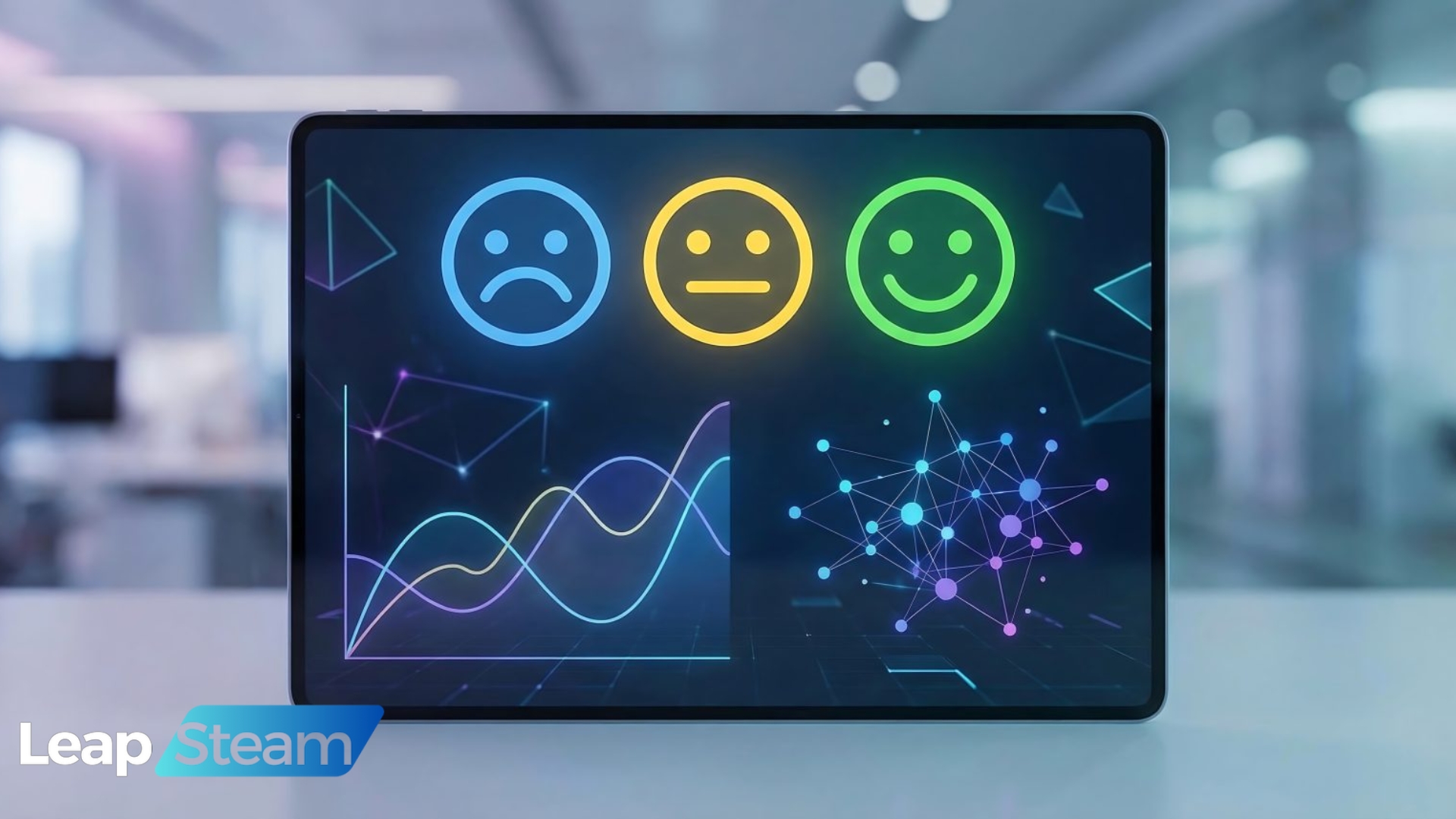
To truly leverage emotional data, you must understand how the technology functions within the lifecycle of a customer interaction. Sentiment analysis operates on two primary timelines: the immediate (real-time) and the historical (post-chat).
Detecting Sentiment in Real Time
Real-time analysis is the frontline defense against customer churn. As a conversation unfolds, the AI continuously updates an “emotional score” visible only to the agent and their supervisors. If a customer begins a chat with a neutral tone (“I need help with my billing”) but suddenly shifts to a negative tone (“Why is this taking so long, this is ridiculous!”), the system immediately flags the interaction.
This real-time flagging allows for instant intervention. A supervisor can seamlessly monitor the chat, quietly message the agent with advice, or take over the conversation entirely to de-escalate the situation. For B2B companies managing high-value enterprise accounts, this instant triaging is critical for preserving fragile client relationships.
Analyzing Chat Data Post-Conversation
While real-time alerts put out immediate fires, post-conversation analysis builds the foundation for long-term strategic improvements. By aggregating thousands of chat transcripts, businesses can identify macro-trends. You might discover that a specific product update launched last week caused a 40% spike in negative sentiment across all support channels. These insights integrate seamlessly with your CRM, providing product and marketing teams with raw, unfiltered customer feedback.
How Sentiment is Scored and Categorized
Modern AI tools do not simply guess; they use rigorous, weighted matrices to assign emotional values. Here is a breakdown of the primary factors analyzed during a chat interaction:
| Analysis Factor | Operational Purpose | Example Trigger |
| Lexical Word Choice | Assesses specific language, adjectives, and tone. | Words like “frustrated,” “broken,” or “amazing.” |
| Contextual Framing | Evaluates the circumstances and phrasing of the exchange. | “I’ve been waiting for two weeks” (High urgency/negative context). |
| Response Patterns | Tracks interaction flow, typing speed, and message length. | Rapid, short messages in all caps indicating rising anger. |
As the machine learning models process more conversations, they become hyper-attuned to the specific vernacular of your industry, ensuring consistent service quality and continuous refinement of your engagement methods.
3. Benefits of Sentiment Analysis in Live Chat
Implementing emotional intelligence into your digital support channels yields massive dividends across three core pillars: customer satisfaction, agent performance, and direct revenue generation.
Enhancing Customer Satisfaction Through Empathy
Sentiment analysis completely changes the game for modern enterprises. When frustration is flagged by the system, routing protocols can immediately bypass standard tier-one agents and connect the angry customer with a senior retention specialist.
Because the system works in real time, businesses can intervene at the exact moment a relationship is at risk. According to research by McKinsey & Company, resolving a customer complaint within the same interaction (First Contact Resolution) fueled by empathetic communication can actually result in a customer who is more loyal than one who never experienced an issue at all, a phenomenon known as the “Service Recovery Paradox.”
Elevating Agent Performance and QA
Traditional Quality Assurance (QA) involves a manager randomly reading five or six chat transcripts per agent each month. This is statistically insignificant. Sentiment analysis allows you to QA 100% of your interactions automatically.
You can instantly see which agents consistently end chats with a positive sentiment score and which agents seem to trigger negative responses. This data provides a roadmap for targeted training:
- Emotional Intelligence: Evaluates an agent’s ability to sense and de-escalate rising tensions.
- Response Effectiveness: Measures how effectively an agent pivots a conversation from negative to neutral.
- Customer Connection: Tracks success in building genuine rapport.
When you utilize customer service outsourcing, these automated metrics are invaluable. They allow you to hold your BPO vendor strictly accountable to hard data, ensuring their agents are representing your brand with the utmost professionalism.
Turning Insights into Lead Conversion
Sentiment analysis is not solely a defensive tool for customer support; it is a highly potent offensive weapon for sales.
Positive sentiment signals high purchasing intent. If an agent is chatting with a user who expresses sheer delight about a software feature, the AI can prompt the agent to seamlessly pivot to a cross-sell or up-sell offer. Conversely, if a B2B client’s sentiment score drops steadily over a month, the system can trigger an automated alert to their designated Account Executive, warning them that the account is at a high risk of churning, giving them time to proactively intervene.
4. Steps to Add Sentiment Analysis to Your Business
Recognizing the advantages of emotional AI is only the first step. Successfully implementing it into your tech stack requires a deliberate, strategic approach.
Choosing the Right Tools and Platforms
Do not settle for generic, out-of-the-box chatbots. You must procure enterprise-grade tools (such as advanced tiers of Zendesk, Intercom, or specialized AI overlays) that offer high-fidelity accuracy, real-time processing, and deep API access.
Key features to demand from your software vendor include:
- Real-time Analysis: For instant agent intervention.
- Multi-language Support: Essential if you operate globally.
- Custom Sentiment Rules: The ability to teach the AI industry-specific jargon (e.g., in software development, the word “bug” is a neutral noun, not a negative complaint about an insect).
Integrating Sentiment Analysis with CRM Systems
Sentiment data isolated in your chat software is virtually useless. It must be integrated into your central source of truth, your CRM (like Salesforce or HubSpot). A robust integration allows for the automatic routing of leads and support tickets based entirely on emotional scores.
How to execute the integration:
- Map Data Properly: Ensure custom fields are created in your CRM so that every contact record displays a “Historical Sentiment Score,” giving your sales team immediate context before they make a phone call.
- Automate Workflows: Build “If/Then” logic. For instance, IF a chat ends with a “Severe Negative” sentiment score, THEN automatically create an urgent follow-up task for the Customer Success Manager.
- Incorporate Lead Scoring: Adjust your marketing qualification formulas so that positive chat sentiment adds points to a lead’s overall score.
The Scaling Factor: Why You Must Outsource Livechat 24/7
Implementing the best sentiment analysis software in the world is entirely pointless if nobody is awake to answer the chat. The internet does not adhere to standard business hours. If a customer is furious at 3:00 AM, the AI will flag it, but without a human agent present to intervene, the customer will simply leave.
To truly capitalize on this technology, you must outsource livechat 24/7. Building an internal team to cover overnight shifts, weekends, and holidays is logistically and financially crippling for most businesses. By partnering with a premium vendor for customer support outsourcing, you gain immediate access to global teams operating across multiple time zones.
Furthermore, elite BPOs allow you to consolidate your operations. You can outsource email support services, social media moderation, and live chat to a single provider. This omnichannel approach ensures that no matter where or when a customer expresses an emotion, a highly trained outsourced professional is there to manage it, guided by your real-time sentiment data.
5. Advanced Ways to Use Sentiment Analysis
Once your baseline systems are operational and your 24/7 outsourced teams are in place, you can push the boundaries of what conversational data can achieve for your enterprise.
Leveraging Predictive Machine Learning
Advanced machine learning algorithms do not just read the current conversation; they predict the future. By analyzing millions of historical data points, predictive AI can look at the first two sentences a customer types and predict with 85% accuracy whether the chat will end in a cancellation request.
This allows your live chat support platform to dynamically route the customer to a specialized “Save Desk” agent before the customer even asks to cancel. This proactive routing fundamentally alters the trajectory of the customer journey.
Regularly Refining Processes and Playbooks
Sentiment analysis is not a “set it and forget it” tool. It requires constant tuning. Businesses must routinely review transcripts where the AI’s sentiment score conflicted with the post-chat survey score (e.g., the AI thought the chat was positive, but the customer left a 1-star review). Finding these discrepancies helps you retrain the machine learning model.
Furthermore, use this data to refine your internal playbooks. If you notice a specific macro (a pre-written templated response) consistently triggers a drop in sentiment, delete it immediately. The data is telling you that your customers find that specific corporate phrasing cold or unhelpful.
Training Teams to Act on Sentiment Data
The most sophisticated AI is useless if the human agent ignores it. When you engage in customer service outsourcing, mandate that your vendor includes sentiment analysis interpretation in their core onboarding curriculum.
Core training must include:
- Interpreting the UI: How to quickly read the emotional dashboards while actively typing a response.
- Pivoting Tone: Training agents to match their communication style to the detected sentiment (e.g., using highly formal, apologetic language for negative scores, and upbeat, conversational language for positive scores).
- Escalation Protocols: Empowering outsourced agents to know exactly when a negative score requires them to transfer the chat to a domestic internal manager.
By weaving these advanced training techniques into your daily operations, you ensure that the synthesis of artificial intelligence and human empathy creates an unbreakable bond with your customer base.
Conclusion
Sentiment analysis is fundamentally rewriting the playbook for digital customer interactions. By analyzing emotional cues in real time, B2B and B2C companies can make instantaneous, data-driven decisions that directly influence customer lifetime value, mitigate churn, and drastically improve agent efficiency.
However, the technology alone is not a silver bullet. Its true power is unlocked only when paired with continuous, 24/7 human availability. By making the strategic choice to outsource livechat 24/7 to a sophisticated BPO partner, you ensure that every emotional signal your customers broadcast is met with immediate, empathetic, and professional human intervention. Embrace the synergy of AI sentiment detection and global outsourced talent, and transform your live chat channel from a standard support cost center into a primary driver of brand loyalty and revenue growth.
Frequently Asked Questions (FAQs)
- What is sentiment analysis of feedback in live chat?
Sentiment analysis uses Natural Language Processing (NLP) and machine learning algorithms to interpret the underlying emotions in text-based customer messages. It automatically classifies the conversation into categories like Positive, Neutral, or Negative. This allows agents to understand the user’s mood instantly, helping them tailor their responses to either capitalize on a positive experience (upselling) or de-escalate a negative one (retention).
- How does sentiment analysis directly improve customer satisfaction (CSAT)?
It improves CSAT by enabling proactive service. Instead of waiting for a customer to formally complain, the system flags frustration based on word choice and typing patterns. This allows a supervisor or a specialized agent to intervene in real-time, resolving the issue before the customer leaves the website angry. According to industry data, resolving issues during the initial interaction drastically boosts CSAT scores.
- Why is it necessary to outsource livechat 24/7 if we have sentiment analysis AI?
Sentiment analysis AI identifies the emotion, but a human must resolve the underlying complex problem. The internet operates 24/7. If a user in a different time zone logs on at 2:00 AM and is highly frustrated (which the AI detects), the lack of a human agent to actually fix the issue will only amplify their anger. Outsourcing ensures that skilled professionals are always available to act upon the AI’s alerts, regardless of the hour.
- How do you integrate sentiment analysis with a CRM?
Integration is typically achieved via API connections between your live chat software (like Zendesk or Intercom) and your CRM (like Salesforce or HubSpot). Once connected, you map the data fields so that the final “Sentiment Score” of a chat is permanently logged in the customer’s contact record. You can then use CRM automation to trigger workflows, such as alerting an Account Executive if a VIP client has a negative chat experience.
- How can sentiment analysis be used to measure outsourced agent performance?
When utilizing customer service outsourcing, sentiment analysis acts as an automated, unbiased QA tool. It tracks the average sentiment score of every chat handled by an individual agent. If a specific agent consistently begins chats that start neutral but end negative, it clearly highlights a gap in their soft skills or product knowledge, allowing BPO managers to implement highly targeted coaching.
- Is it beneficial to outsource email support services alongside live chat?
Absolutely. Taking an omnichannel approach to customer support outsourcing ensures a seamless customer experience. By using the same BPO for both email and live chat, you unify your brand voice. Furthermore, many modern helpdesk platforms apply sentiment analysis to emails as well, allowing your outsourced teams to prioritize their email ticketing queue based on the urgency and emotional distress of the sender.
- Are there privacy concerns with AI reading customer chat messages?
Data privacy is critical. Reputable sentiment analysis tools and premium BPO providers comply with major privacy regulations like GDPR and CCPA. The AI processes the text for emotional context, and enterprise-grade systems automatically redact Personally Identifiable Information (PII) like credit card numbers or social security details before the data is stored or analyzed for macro-trends.
- What features should I look for when choosing a sentiment analysis tool?
When evaluating tools, prioritize platforms that offer real-time detection (not just post-chat reporting), seamless native CRM integrations, high-fidelity accuracy for industry-specific jargon, multi-language support (crucial for global e-commerce), and granular reporting dashboards that allow your management team to track emotional trends over time.