
Navigating the world of business process outsourcing (BPO) can feel overwhelming for business leaders. When deciding to scale operations, you are immediately confronted with industry jargon that sounds identical but carries vastly different strategic implications. Understanding the exact distinctions between outsourcing, offshoring, and nearshoring is critical before you make any binding vendor decisions. If you want to efficiently outsource customer service, lowering costs while maintaining high-quality brand experiences, you must choose the right geographic and operational model. This comprehensive 2026 guide breaks down these definitions, helping you identify the perfect structural fit for your growing organization’s unique needs.
1. What are Outsourcing, Nearshoring, Offshoring?
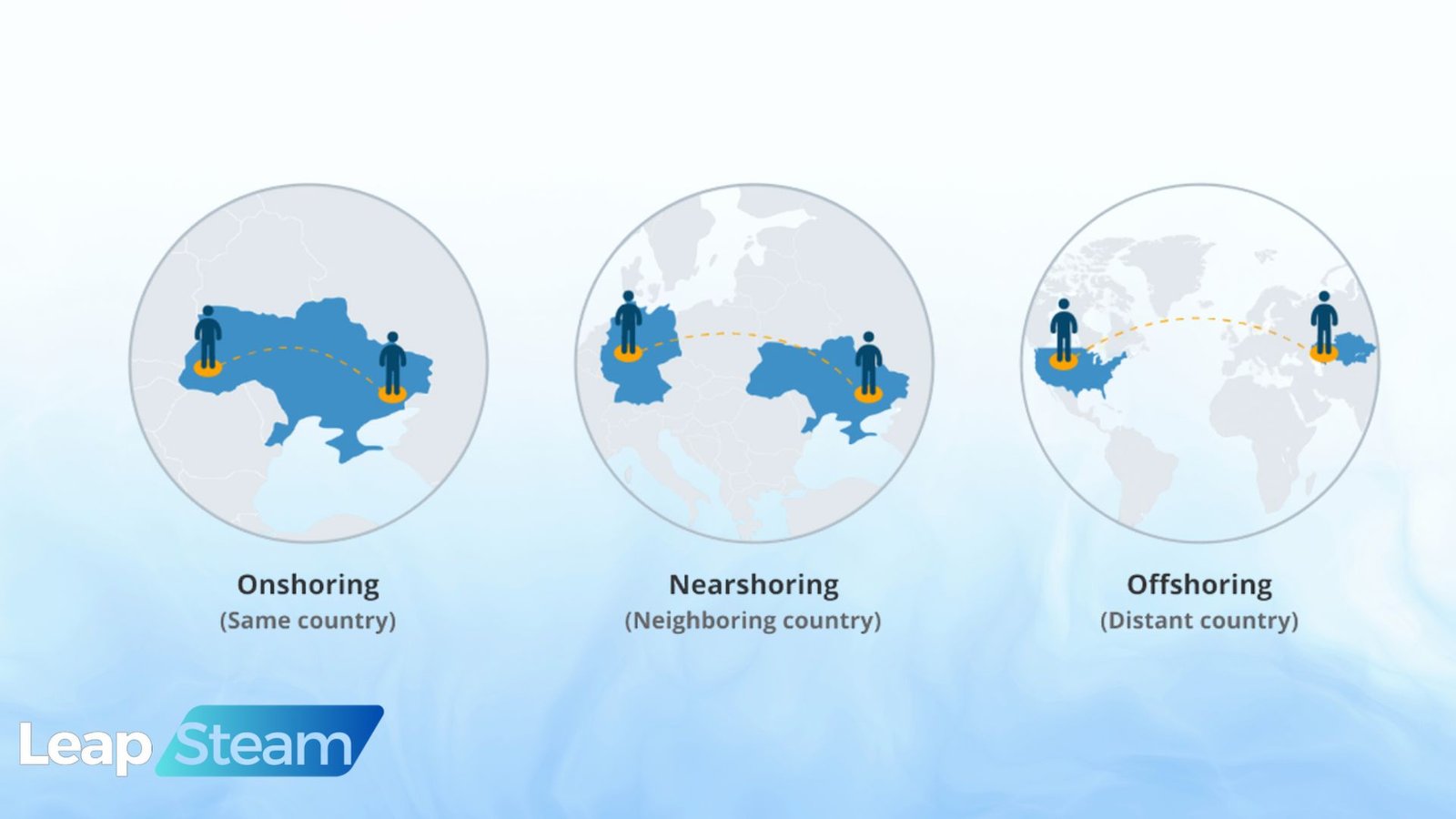
To make the best operational decision for your enterprise, you must first decipher the terminology. These three terms are frequently used interchangeably in boardrooms, but they represent entirely different logistical strategies.
Outsourcing: The Strategic Umbrella. Think of outsourcing as the overarching umbrella under which all other models sit. Outsourcing is simply the business practice of contracting a third-party individual, agency, or enterprise to perform tasks, handle operations, or provide services that were previously executed by your in-house employees. The defining characteristic of outsourcing is the transfer of operational responsibility to an external entity, regardless of their geographical location. Whether the vendor is located three blocks away from your headquarters or on the other side of the planet, if they are not on your direct internal payroll, the process is outsourced.
Nearshoring: The Neighboring Advantage. Nearshoring is a specific subset of outsourcing. It occurs when a business delegates a process or service to a third-party vendor located in a neighboring country, usually within the same or a very similar time zone. The prefix “near” highlights the geographical proximity. For example, a technology company headquartered in the United States might partner with a nearshore BPO in Mexico or Colombia. A business based in the United Kingdom might nearshore its IT operations to Poland or Romania. This model bridges the gap between massive cost savings and operational proximity.
Offshoring: The Global Expansion. Offshoring occurs when a company relocates business processes or services to a third-party vendor in an entirely different geographical region typically overseas. When most executives discuss plans to outsource customer service, they are usually referring to offshoring. For instance, an e-commerce brand based in Australia might hire a dedicated team of customer experience representatives in the Philippines, or a financial firm in Canada might contract an accounting team in India. Offshoring is traditionally pursued to access massive, highly educated talent pools at a fraction of domestic labor costs.
2. Types of Customer Support Outsourcing
To truly grasp how these models function, it helps to look at them applied in real-world scenarios. Because outsourcing is such a broad operational concept, it can be customized to fit virtually any business size, industry, or specific departmental need. Here is how different variations of outsourcing manifest in practice:
Scenario A: The Onshore Freelance Model. A boutique digital marketing agency based in New York City realizes they are spending too much time on tedious administrative tasks. Instead of hiring a full-time administrative assistant, they use an online talent marketplace to hire an independent contractor based in Ohio to manage their calendar and inbox. This is domestic outsourcing (or onshoring). It provides flexibility and eliminates the overhead of a full-time salary and benefits, though it rarely offers the aggressive cost savings of international models.
Scenario B: The Nearshore Bilingual Hub. A rapidly expanding logistics company based in Texas notices a massive surge in Spanish-speaking clientele. To provide culturally resonant support, they partner with a nearshore BPO in Monterrey, Mexico. This nearshore team manages the company’s inbound call center. Because the time zones align perfectly with the American South, the nearshore team functions seamlessly alongside the internal Texas staff, executing daily operations without any severe temporal lag.
Scenario C: The Comprehensive Offshore Operation. A massive global SaaS (Software as a Service) provider headquartered in Silicon Valley needs to provide guaranteed 24/7 technical support. To achieve this, they deeply invest in customer service outsourcing by establishing an offshore partnership in Manila, Philippines. The offshore team handles overnight email tickets, live chat support, and complex data entry and processing services. While the internal California team sleeps, the Manila team ensures that global enterprise clients receive immediate assistance, essentially keeping the business running 24 hours a day.
These scenarios illustrate that outsourcing is not a rigid monolith. It is a highly malleable strategy. You can use it to augment a single missing skill set or to manage the entire backend infrastructure of your corporation.
3. The BPO Breakdown: Exploring Your Support Options
Why are so many modern enterprises aggressively pushing to externalize their workflows? The reasons to outsource customer service are deeply rooted in operational efficiency and strategic growth. According to a 2025 Global Shared Services Report by Deloitte, over 76% of executives leverage third-party vendors not just to cut costs, but to rapidly accelerate their digital transformation and scale their service capabilities.
If you are exploring the BPO landscape, here are the primary catalysts driving companies toward these models:
- Eradicating the Talent Shortage: In highly competitive domestic markets, finding and retaining skilled talent is an agonizing and expensive process. Outsourcing grants immediate access to a global talent pool. If you need 50 trained technical support agents by next month, a strong BPO partner can deploy them instantly.
- Focusing on Revenue Generation: Every hour your executive team spends managing a contact center schedule or overseeing data entry and processing services is an hour stolen from product innovation and sales. By delegating these value-neutral tasks, you liberate your core team to focus entirely on business-critical, revenue-generating growth.
- Unlocking Premium Infrastructure: Small and mid-sized businesses (SMBs) often cannot afford enterprise-grade omnichannel helpdesk software, AI-driven sentiment analysis tools, or advanced cybersecurity infrastructure. When you partner with a premium BPO, you inherit their state-of-the-art technological ecosystem for a fraction of the cost.
- Scaling with Elasticity: Business volume fluctuates. Managing the chaotic surge of the winter holidays or a sudden viral marketing campaign is nearly impossible with a static internal team. Outsourced support teams provide operational elasticity, allowing you to scale headcount up by 200% during peak seasons and scale it back down when traffic normalizes.
Every growing enterprise will eventually face the operational limits of their internal infrastructure. Understanding that you need to outsource is the first step; determining where to outsource is the crucial second step.
4. Can Nearshoring Work for Your CX Business?

If an organization decides to cross international borders for their operational needs, they must carefully weigh the pros and cons of nearshoring versus offshoring. Nearshoring has seen a massive surge in popularity over the last few years, particularly for North American companies looking toward Latin America (LATAM).
The Unique Benefits of Nearshoring. Nearshoring is incredibly attractive to businesses that prioritize real-time collaboration. The primary advantage is time zone alignment. When your external team is only one or two hours ahead or behind your headquarters, scheduling video meetings, executing daily Agile stand-ups, and managing collaborative projects becomes entirely frictionless.
Furthermore, nearshoring often provides cultural affinity. Consumers in the United States and Canada share many cultural touchpoints with consumers in Mexico, Costa Rica, or Colombia. This cultural overlap can be highly beneficial when agents need to build rapid rapport with frustrated callers. Finally, executive travel is vastly simplified. Flying from Chicago to Bogotá for a quarterly vendor review takes a few hours; flying to Mumbai takes over a day.
The Inherent Risks of Nearshoring. However, nearshoring is not without its distinct challenges. First and foremost is the cost. While cheaper than domestic labor, nearshoring is significantly more expensive than offshoring to Asia. If aggressive cost reduction is your primary objective, nearshoring may not hit your financial targets.
Additionally, linguistic barriers must be carefully vetted. While English proficiency is growing rapidly in LATAM regions, it does not always match the deep, institutionalized bilingualism found in traditional offshore hubs. Finally, the BPO infrastructure in some emerging nearshore countries is relatively new. It takes decades for a country to establish the robust cybersecurity laws, telecom infrastructure, and university-level BPO training pipelines required to support enterprise-scale operations securely.
5. Expand Reach: Nearshoring vs Offshoring
When comparing nearshoring directly to offshoring, it is vital to dispel the outdated myths surrounding offshore destinations. Decades ago, offshoring was synonymous with cheap labor and poor quality. In 2026, offshore hubs like the Philippines and India represent the absolute gold standard of the global service industry.
The Unmatched Power of Offshoring. Choosing to offshore comes with a massive array of undeniable benefits:
- Maximized Cost Efficiency: The economic disparity between Western nations and offshore hubs allows companies to secure top-tier, university-educated talent at 50% to 70% lower operational costs.
- The “Follow-the-Sun” Model: The drastic time zone difference is often framed as a negative, but for customer support, it is a superpower. While your internal team sleeps, your offshore team in Manila is working their standard day shift, providing your customers with seamless, 24/7 global coverage.
- Deep Industry Infrastructure: Countries like the Philippines have literally built their modern economies around the BPO sector. Whole metropolitan areas are designed to support 24-hour business cycles, ensuring that your outsourced support teams have reliable public transit, lightning-fast fiber internet, and safe working environments at any hour of the day.
Mitigating Offshore Risks Through Strategic Partnerships The historical concerns associated with offshoring communication breakdowns, security risks, and loss of control are rarely the fault of the geographical model itself. Almost exclusively, these failures are the result of choosing a disreputable, budget-tier vendor.
A premium offshore BPO functions as a strategic partner, not a transactional vendor. They will aggressively invest in agent retention, ensuring that your customers speak to the same experienced representatives for years, not a revolving door of new trainees.
When it comes to data security, established offshore destinations are heavily regulated. A legacy provider will hold strict ISO 27001 certifications, SOC 2 Type II compliance, and robust GDPR data privacy frameworks. If your objective is to outsource customer service securely, partnering with a deeply established offshore provider often yields better data protection than hiring an internal domestic team without enterprise-level IT support.
6. Determining Whether Outsourcing, Nearshoring, or Offshoring Is Better
Ultimately, the decision between outsourcing domestically, nearshoring to a neighboring country, or offshoring across the globe is entirely dependent on your organization’s unique operational DNA. There is no universally “perfect” model, only the model that perfectly aligns with your current bottlenecks and future ambitions.
If you require constant, real-time collaboration with your vendor and are willing to pay a premium for geographical proximity, nearshoring is an excellent choice. However, if your primary objectives are to secure massive cost savings, establish a true 24/7 support infrastructure, and tap into a highly mature, deeply experienced global talent pool, offshoring remains the undisputed champion of customer service outsourcing.
To guarantee success, avoid forcing your company into a rigid, predetermined template. Consult with a BPO provider that possesses a proven, decades-long track record. A true partner will conduct a deep audit of your current workflows and engineer a bespoke outsourcing architecture tailored specifically to secure your long-term growth.
Frequently Asked Questions (FAQ)
- What is the fundamental difference between outsourcing and offshoring?
Outsourcing is the general business practice of hiring a third-party company to handle a specific operational task, regardless of where that company is located (even if they are in the same city as you). Offshoring is a specific type of outsourcing where you hire a third-party company located in a completely different geographical region (like moving a US-based process to India or the Philippines).
- Is it safe to hand over our data entry and processing services to an offshore team?
Yes, provided you partner with a reputable, enterprise-grade BPO. Premium offshore providers operate under incredibly strict, globally recognized data security frameworks, such as ISO 27001, HIPAA, and SOC 2 Type II. Their facilities often feature biometric access controls, clean-desk policies, and heavily encrypted network infrastructures that match or exceed domestic security standards.
- How much money can a company realistically save by choosing to offshore?
While exact figures depend on the complexity of the roles and the specific technology required, companies that move operations from the United States or the UK to offshore hubs like the Philippines typically experience operational cost savings ranging from 50% to 70%. This calculation includes the reduction in overhead costs like office space, HR benefits, software licensing, and recruitment.
- What is onshoring or domestic outsourcing?
Onshoring is the process of delegating a business function to a third-party vendor located within the borders of your own country. For example, a tech firm in San Francisco might outsource their basic customer support to a call center located in Ohio. It offers the easiest cultural alignment and legal simplicity but provides the lowest potential for cost savings.
- How do offshore BPOs manage the extreme time zone differences?
Countries with mature BPO industries are culturally and structurally adapted to global business hours. In offshore hubs, massive segments of the workforce operate on the “night shift” to align perfectly with North American or European daytime hours. Furthermore, reputable BPOs offer shift-differential pay to ensure their agents maintain an excellent quality of life while working non-traditional hours.
- Will our customers be frustrated by language barriers if we outsource customer service offshore?
Not if you choose your destination and vendor wisely. The Philippines, for instance, boasts one of the highest English proficiency rates in the world, with an educational system deeply rooted in Western linguistics and cultural nuances. Premium BPOs also invest heavily in continuous voice, accent, and cultural alignment training to ensure completely frictionless customer interactions.