
In logistics and freight, margin is dictated by operational efficiency. When dispatchers, freight brokers, and account managers spend the majority of their day responding to status update requests, retrieving documents, and scheduling appointments, your highest-cost staff are performing work that does not require their expertise. According to the Council of Supply Chain Management Professionals (CSCMP) 2024 Annual Report, administrative communication tasks consume an average of 38% of logistics coordinators’ working hours in US 3PL operations hours that could be directed at capacity procurement, carrier relationship management, and revenue-generating activity. Here are the eight operational tasks logistics companies should delegate when they outsource email support to a specialized BPO partner.
1. Track and Trace – Status Update Requests
Track and trace constitutes the highest volume of inbound email traffic for any logistics company. Shippers and receivers demand ETA updates continuously, particularly for high-value, time-sensitive, or temperature-controlled freight where a missed delivery window carries direct financial consequences.
Having a $60,000–$80,000 per year account manager manually check GPS pings or call carriers to reply to a status email is one of the most common and costly operational inefficiencies in US 3PL operations. When companies outsource email support for this task, a dedicated BPO team is granted limited, role-based access to the Transportation Management System (TMS) or tracking portal. They intercept inbound status requests, locate the shipment, and return a standardized ETA update to the client typically within minutes rather than hours. For high-volume shippers submitting multiple daily inquiries, this single delegation can eliminate dozens of internal interruptions per day.
2. Document Retrieval and Distribution
Logistics runs on paperwork. Bills of Lading (BOL), Proof of Delivery (POD), commercial invoices, weight tickets, and customs declarations are requested constantly by customers, carriers, and finance teams to authorize payments, clear shipments, and close billing cycles.
A dedicated outsource email support team acts as a document control hub for this traffic. Operating from a designated inbox (e.g., documents@yourcompany.com), the BPO team locates requested files in your internal database, verifies that documents are legible and complete, and distributes them to the requesting party within your defined SLA window. This removes a high-volume, low-complexity task from your operations team entirely and accelerates your clients’ billing cycles as a direct result.
3. Freight Appointment Scheduling
Moving LTL (Less Than Truckload) or FTL (Full Truckload) freight requires precise coordination with warehouse and distribution center facilities. Missed delivery appointments generate detention fees, disrupt supply chain sequences, and damage carrier relationships all of which are avoidable with timely scheduling.
The appointment lifecycle is highly repetitive and entirely email-driven: receive the tender, contact the receiving facility to secure a dock door time, log the appointment number into the TMS, and send confirmation to the carrier. An outsourced email support team takes ownership of this full cycle. Internal staff receive a completed appointment log rather than managing each coordination exchange individually.
4. Claims Processing Intake
Freight damage and shortages are operationally inevitable. However, the initial phase of processing a freight claim — collecting photos, receiving the formal notice of intent, gathering the original commercial invoice and packing slip is purely administrative work that does not require the judgment of an experienced claims adjuster.
When companies outsource email support for claims intake, the BPO team manages this front-end documentation phase. They ensure all required materials are submitted before legal filing deadlines expire, review intake packages for completeness, and organize the file. Only when the claim packet is fully documented does the outsourced team escalate to your internal adjuster for liability determination. This prevents incomplete claims from reaching your senior staff and ensures filing deadlines are not missed due to administrative backlog.
5. Carrier Onboarding and Compliance Checks
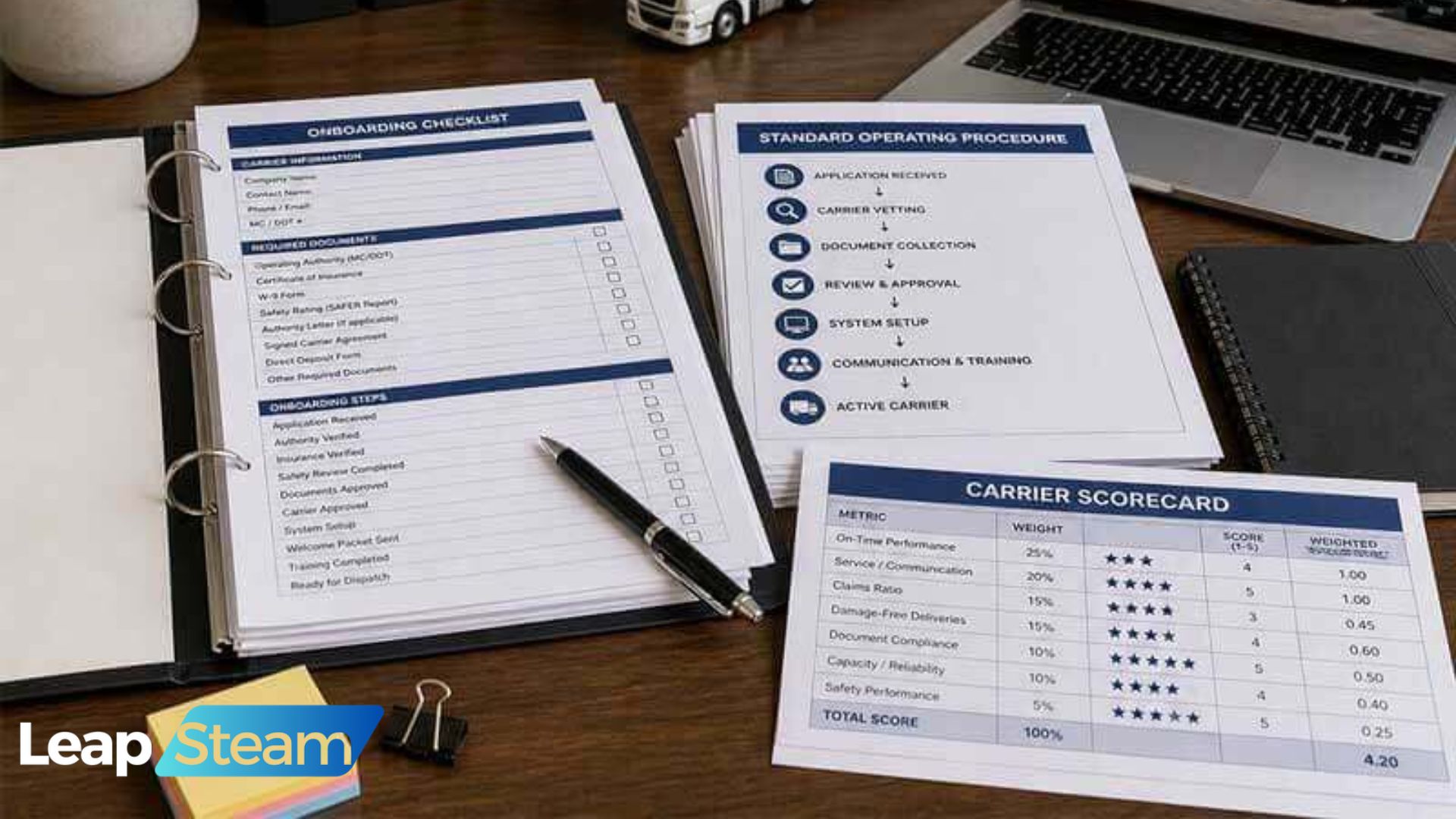
Brokerages and 3PLs must continuously onboard new carriers to maintain and expand capacity. Each onboarding requires collecting W-9s, verifying operating authority (MC/DOT numbers), and obtaining current certificates of insurance (COI). Ongoing compliance monitoring is equally critical for a carrier whose insurance lapses must be flagged and removed from active dispatch immediately.
An outsourced email support team can manage the full compliance loop: executing proactive email campaigns requesting updated insurance documents from the carrier base, processing returned paperwork, updating carrier profiles in your TMS or carrier management system, and flagging lapsed or non-compliant records for dispatcher review. According to FreightWaves’ 2024 Carrier Compliance Report, insurance lapses account for 23% of freight broker compliance violations, the majority of which occur because manual monitoring processes fail to catch renewals in time. Delegating this function to a dedicated team eliminates that gap.
6. Basic Freight Quoting
Complex multi-modal or project freight requires experienced logistics professionals to price accurately. Standard spot market quotes, however, are largely formula-driven pulling dimensions and weights, running parameters through a rating engine or tariff sheet, and returning a formatted rate to the customer.
Outsourcing email support for standard quoting requests allows logistics companies to respond to spot freight inquiries in under 15 minutes, a response time that Freightos data identifies as a significant factor in spot market win rates, with shippers selecting the first qualified quote in the majority of competitive quote scenarios. Internal brokers focus on negotiating complex or high-margin lanes, while the BPO team ensures routine volume receives a competitive response speed.
7. Exceptions Management and Proactive Notification
When a truck breaks down, a terminal experiences congestion, or weather delays a route, proactive communication with the affected shipper is the difference between a managed service failure and a damaged relationship. Waiting for the customer to ask why their freight is late is the worst available response to an exceptional event.
An outsourced email support team can be configured to monitor exception reports generated by the TMS. When an exception triggers, the team follows a defined Standard Operating Procedure (SOP) to draft and send a proactive notification to the affected shipper including the nature of the delay, estimated impact on delivery window, and next steps. This proactive communication converts a supply chain disruption into a demonstration of service reliability, and removes the burden of exception monitoring from dispatchers managing active loads simultaneously.
8. Invoice Auditing and Discrepancy Resolution
Carriers frequently submit invoices that do not match the original rate confirmation adding accessorial charges for detention, lumper fees, layover, or fuel surcharges that were not authorized in the original agreement. Before your finance team processes payment, each discrepancy must be identified and resolved.
An outsourced email support team serves as the first line of defense for accounts payable. They compare each carrier invoice against the signed rate confirmation and submitted POD, identify unauthorized line items, and contact the carrier directly to request receipts or justification. Your finance team receives only verified, reconciled invoices for final processing. According to Armstrong & Associates’ 2024 3PL Market Research, invoice discrepancies and accessorial disputes consume an average of 11 hours per week per accounts payable staff member in mid-size US 3PL operations, a recoverable cost for companies that delegate this function to an outsourced support partner.
Conclusion
The logistics and freight industry generates administrative email volume that scales directly with shipment volume and the majority of that volume does not require the expertise of the people currently handling it. Dispatchers, brokers, and account managers are expensive, specialized resources. Routing high-volume, repetitive communication tasks through them is a structural inefficiency that limits capacity procurement, account growth, and margin.
When logistics companies outsource email support for the eight task categories above, they recover thousands of staff hours annually and redirect their highest-cost employees toward the revenue-generating work those roles were designed to perform. The operational leverage gained is immediate and measurable in response times, billing cycle speed, compliance rates, and the attention your team can give to the customers and carriers that actually require it.
Frequently Asked Questions
How do we ensure an outsourced team understands logistics terminology and workflows?
Partner with a BPO provider that offers industry-specific outsource email support services for the supply chain sector not a generalist call center. During onboarding, agents must be trained on your specific TMS, your carrier and customer communication standards, and the terminology of your operational niche (LTL, FTL, BOL, accessorials, detention, etc.). Request a sample onboarding plan and verify that logistics-specific training is a structured component, not an informal orientation.
Is it safe to give an outsourced team access to our TMS?
Yes, with proper access controls. Use Role-Based Access Control (RBAC) to provision outsourced agents with the minimum permissions required for their specific tasks viewing shipment statuses, uploading documents, updating carrier profiles without access to financial records, rate negotiations, or system configuration. Audit agent activity logs regularly, particularly in the first 90 days of the engagement.
What SLA targets should we set for logistics email support?
For track and trace and document retrieval the two highest-volume task categories a first response time of 30–60 minutes during business hours is a standard contractual target for competent outsource email support services providers. For exception notifications, the SLA should be measured from the time the TMS exception triggers to the time the proactive customer email is sent, typically 15–30 minutes for well-structured teams with defined SOPs.
How does the outsourced team integrate with our existing US logistics staff?
The outsourced team operates as Tier 1 support within your existing ticketing system Zendesk, Front, or equivalent. Routine tasks are resolved independently. Escalations, severe claims, complex routing failures, high-value customer disputes are tagged to the appropriate internal account manager with a clean summary of the situation and all relevant documentation attached. Your US team engages only when the issue genuinely requires their judgment or relationship authority.
Leap Steam provides outsource email support services for US logistics companies, 3PLs, freight brokers, and freight tech platforms. Our operations-trained teams handle track and trace, document management, carrier compliance, and invoice auditing integrated directly with your TMS and ticketing systems.